
When choosing sand for a project in Islamabad, Rawalpindi, Taxila or Wah Cantt, the source name is only part of the decision. Particle size, grading, cleanliness, intended use and delivered cost all matter. Ghazi sand and Lawrencepur sand are two names buyers meet in this market, and they are usually bought for different jobs rather than as substitutes.
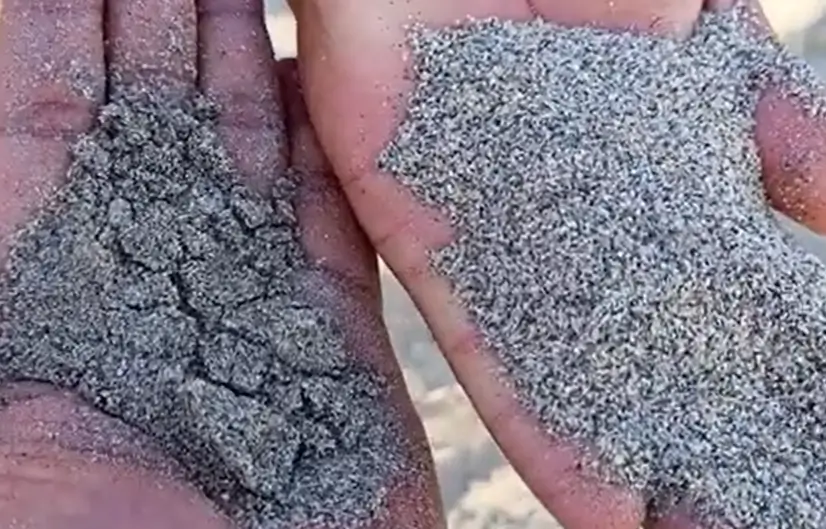
Quick answer: Ghazi sand is a fine-grained sand supplied mainly for plastering and wall finishing. Lawrencepur sand is coarser, contains gravel particles, and is used for concrete and brickwork. They come from different regions and serve different purposes, so the right choice depends on the job, not on which name sounds better.
Quick comparison: Ghazi sand vs Lawrencepur sand
| Factor | Ghazi sand | Lawrencepur sand |
|---|---|---|
| Texture | Fine-grained | Coarser, contains gravel particles |
| Typical use | Plastering and wall finishing | Concrete and brickwork |
| Fineness modulus (FM) | Not published as an FM figure. See our sieve analysis guide for mesh-passing results. | Reported as roughly 2.2 to 3.4 |
| Source region | Ghazi–Tarbela region, Khyber Pakhtunkhwa | Attock district, Punjab |
| Silt, clay and contamination | Verify through inspection and testing | Verify through inspection and testing |
| Delivered price | Get a current quotation for your destination and load size | Get a current quotation for the same destination and load size |
| Best way to compare | Sample inspection, grading results and a trial mix | Sample inspection, grading results and a trial mix |
The practical takeaway: these two materials are generally not interchangeable for the same job. Ghazi sand is supplied for plastering, and Lawrencepur sand is used where a coarser, concrete-grade aggregate is needed. Either way, confirm the delivered batch against your project’s requirements.
What is Ghazi sand?
Ghazi sand is a fine-grained sand from the Ghazi–Tarbela region of Khyber Pakhtunkhwa. It is supplied for plastering, rendering and wall finishing, not as a general-purpose or structural-concrete sand. See what Ghazi plaster sand is for its origin and applications.
For plastering, buyers look for material that makes a workable mortar and a smooth wall finish. A source name and appearance alone do not establish grading, silt content or other quality characteristics, so check the delivered batch rather than relying on a supplier’s description.
What should you check in Ghazi plaster sand?
- Appearance: colour, and whether the sample has stones, clay lumps, roots or other unwanted material.
- Particle grading: a sieve analysis shows the size distribution. Our lab report guide explains what to ask for.
- Cleanliness: investigate excessive silt or clay where there is reason for concern.
- Consistency: compare samples from different deliveries on large projects.
- Performance: test it in a trial mix that follows your specified mortar proportions.
A light-grey colour or smooth feel may help describe a sample, but neither proves it meets a technical specification.
What is Lawrencepur sand?
Lawrencepur sand is named after the Lawrencepur area of Attock district, Punjab, and is a recognised source name for concrete and brickwork sand in the regional market. It is coarser than Ghazi sand and contains gravel particles, with a reported fineness modulus of roughly 2.2 to 3.4. You may see it spelled Larnas Pur, Larnes Pur or Larnespur in supplier listings.
The properties of a given delivery should still be established from the actual material. It would be misleading to assume every load sold under this name has identical grading or cleanliness, and the same applies to any source. For concrete, base the decision on the relevant specification and test results, not the source name.
Source and scale: where each sand comes from
The two sands come from different provinces, roughly 28 km apart. Ghazi sand is mined near Tarbela Dam in Khyber Pakhtunkhwa, and Lawrencepur sand in Attock district, Punjab. The scale of extraction differs too, which affects how each is typically used and supplied.
| Ghazi sand mine | Lawrencepur sand deposits | |
|---|---|---|
| Location | Khyber Pakhtunkhwa, near Tarbela Dam | Attock district, Punjab |
| Distance between the two | Approximately 28 km | |
| Number of blocks | 2 | 8 |
| Number of mines | 1 mine | 20 mines |
| Operational mines | 1 of 1 | 12 of 20, generally supplying concrete-grade sand for higher-strength concrete work |
These figures describe the scale of extraction, not which material is better. More operational mines at Lawrencepur reflects the scale needed to supply concrete and construction aggregate to a wider market. It does not make Lawrencepur sand suitable for plastering, and it does not make Ghazi sand suitable for structural concrete.
The main differences to evaluate
Particle size and grading
Particle size is the dimension of individual grains. Grading is how those sizes are distributed through a sample. Two sands can look alike yet give different sieve results. For plastering, excessively coarse material is hard to finish smoothly, while too many very fine particles can affect water demand and workability. A sieve analysis tells you more than “fine” or “coarse” alone.
Silt, clay and other unwanted material
Unwanted material can affect the performance and consistency of a mix. Do not judge quality by colour or a hand test alone. A visual check can reveal stones, clay lumps or organic matter, but where suitability is uncertain, ask for testing.
Workability during plastering
Workability is how readily a mortar can be mixed, handled and applied. It depends on grading, water content, binder proportions and the surface. The best test is a controlled trial batch compared under similar conditions.
Wall finish and curing
Finished plaster depends on more than the sand: mortar proportions, substrate preparation, thickness, workmanship and curing all contribute. No source name can guarantee a crack-free wall or remove the need for proper curing.
Consistency between deliveries
Natural materials vary, and a sample may not perfectly represent every truckload. For larger projects, agree the required material characteristics in advance and keep records of quotations, quantities and any test reports.
Which sand is right for your job?
It is less about which sand is “better” and more about which job you are doing.
- Plastering and wall finishing: Ghazi sand’s fine grading is why it is supplied for this work. See why Ghazi sand is preferred for plastering in Islamabad.
- Concrete and brickwork: this calls for a coarser, well-graded aggregate of the kind Lawrencepur sand is generally supplied for. Confirm the delivered material’s fineness modulus and grading against your concrete specification and the engineer’s requirements.
- Identify the application: interior plaster, exterior plaster, concrete or brickwork.
- Inspect a representative sample for contamination or unusual variation.
- Request test results where needed: sieve analysis, and FM for concrete-grade sand.
- Prepare a trial mix and compare workability and finish.
- Follow project specifications and get the engineer’s approval for any change.
How to compare prices fairly
A lower price per cubic foot does not mean lower total cost if load size, distance, included charges or material condition differ. When requesting a quotation for either material, confirm:
- Price at the source, if available
- Loading charges and applicable fees
- Truck or dumper capacity in CFT
- Transport cost to your exact location
- Whether the quantity is measured or estimated
- Unloading or other additional charges
- The date and validity of the quotation
Get quotations for the same destination and comparable loads on the same date. Rates change with transport, fuel, loading conditions and location, so compare current quotations rather than a fixed price difference.
A practical checklist before ordering sand
- Confirm the intended use: plastering, or concrete and brickwork.
- Request a sample and inspect it.
- Ask for grading or laboratory results where needed.
- Confirm truck capacity and quoted volume.
- Compare delivered quotations for the same destination.
- Check what loading, transport and other charges are included.
- Agree expected characteristics for repeat deliveries.
- Get approval from the responsible project professional when required.
How to assess sand quality using test results
A test report is stronger evidence than a general statement about a source. Check that it identifies the material, the date, the tests and the results. For cement-based plaster, ASTM C897 describes requirements for aggregates in job-mixed Portland cement-based plasters, including grading. ASTM C33/C33M covers grading and quality for concrete aggregates. These are useful references, but the project specification and local requirements decide which criteria apply.
- ASTM C897: Aggregate for Job-Mixed Portland Cement-Based Plasters
- ASTM C33/C33M: Concrete Aggregates
Passing one test does not establish suitability for every application.
Frequently asked questions
What is the main difference between Ghazi sand and Lawrencepur sand?
Ghazi sand is fine-grained and supplied for plastering and wall finishing. Lawrencepur sand is coarser, contains gravel particles and is used for concrete and brickwork. They come from different regions, about 28 km apart, and are generally not substitutes for the same job.
Can Lawrencepur sand be used for plastering?
It is not generally recommended. Its coarser texture and gravel content can give a rough, hard-to-finish surface. Screening can change the size distribution, but it adds waste and labour and does not by itself prove the result meets plaster requirements.
Can Ghazi sand be used for concrete?
Ghazi sand is supplied for plastering and finishing, not structural concrete. Approval of material for any structural use belongs to the responsible engineer.
What is fineness modulus (FM), and why does it matter?
FM is a number calculated from a sieve analysis that indicates how coarse or fine a sand is. A higher number means coarser material. Lawrencepur sand is reported at roughly 2.2 to 3.4, in the range typically expected for concrete sand. Ask for the sieve analysis itself rather than relying on the FM alone.
How can I check sand grading?
A sieve analysis measures the distribution of particle sizes. Compare the results with the requirements for your use, and ask the supplier for a dated report where quality matters.
Does the colour of sand prove its quality?
No. Colour helps describe a sample but does not establish grading, cleanliness or suitability. Testing and inspection are more reliable.
Why do sand prices differ between suppliers?
Source, material characteristics, load size, transport distance, loading arrangements and included charges all play a part. Compare total delivered quotations, not just a headline rate.
How much sand do I need before I compare prices?
Work this out first, so you compare quotations for the right quantity. Our estimation guide covers wall area, plaster thickness and mix ratio.
Conclusion
The useful comparison is not between two source names. Ghazi sand and Lawrencepur sand generally serve different jobs: fine plastering work on one side, concrete and brickwork on the other. Check grading and cleanliness, compare equivalent quotations and follow your project’s material requirements. That is a more reliable basis for choosing sand than assumptions about either source.
Related guides
- What Is Ghazi Plaster Sand?
- How Much Sand Is Needed to Plaster a House?
- Ghazi Sand Lab Report and Sieve Analysis
- Why Ghazi Sand Is Preferred in Islamabad
For plastering jobs, Ghazi Sand Supply Company can provide a quotation based on your quantity and delivery location: +92 318 5907006 (phone and WhatsApp).