
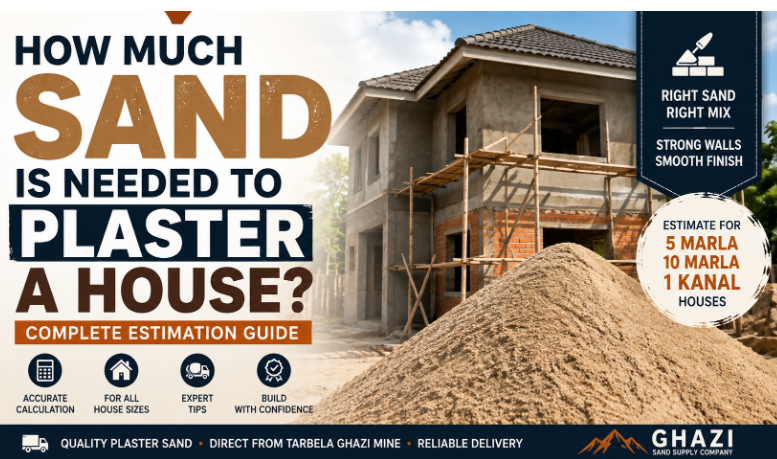
A typical 5 Marla house needs approximately 250 – 350 cubic feet of plaster sand, while a 10 Marla house usually needs 500 – 700 cubic feet. The exact figure depends on wall area, plaster thickness, and your cement-to-sand mix ratio. All of it is explained below, with a worked example you can use for your own house.
Quick answer: Plaster sand quantity = wall area × plaster thickness × sand share of your mix. For a standard 12 mm plaster coat at a 1:4 cement-sand ratio, budget roughly 0.9 to 1.1 cubic feet of sand per 10 square feet of wall surface, plus 5 to 8% for wastage.
Key takeaways
- Sand quantity depends on wall area, plaster thickness, mix ratio and wall condition, not just floor size.
- Ceilings and exterior walls are commonly forgotten during estimation, which leads to shortages.
- A 1:4 cement-sand ratio at 12 mm thickness is the most common residential plaster spec in Islamabad and Rawalpindi.
- Always add 5 to 8% extra sand to cover transport and handling wastage.
- Fine, low-silt plaster sand reduces cracking. Cheap sand can cost more in repairs.
Why accurate plaster sand estimation matters
Getting your plaster sand quantity right before the first dumper arrives is one of the most underrated steps in a construction budget. Order too little and your masons sit idle waiting for a second delivery. Order too much and you have paid to transport sand you did not need, and you are left storing it, often losing quality to rain and contamination.
A reliable estimate helps you:
- Avoid mid-project delays caused by material shortages
- Cut unnecessary dumper and truckload transport costs
- Reduce leftover material and site waste
- Keep plaster quality consistent across the whole house
- Plan your budget with fewer surprises
7 factors that determine how much plaster sand your house needs
1. Total wall and ceiling surface area
This is the biggest driver of your calculation. A double-story house with more internal partitions needs considerably more sand than a single-story home of the same plot size, simply because there is more surface to cover.
2. Plaster thickness
Interior walls are typically plastered at 12 to 15 mm. Exterior walls are usually thicker, since they must withstand weather, and thicker plaster directly increases the sand needed per square foot.
3. Cement-to-sand ratio
Common residential plaster mixes are 1:4, 1:5 and 1:6 (cement:sand). A higher sand share means more sand by volume. Confirm the exact spec with your engineer or contractor before ordering.
4. Wall and brickwork condition
Old or uneven walls soak up more mortar to reach a flat, smooth finish. Fresh, well-aligned brickwork is more predictable and generally uses less plaster sand.
5. Number of floors
Every extra floor adds wall and ceiling area. Ceiling plaster is frequently left out of early estimates, which is one of the most common reasons sites run short.
6. Interior partitions and room layout
Two houses with the same covered area can need very different quantities depending on how many rooms and internal walls they have.
7. Material wastage during handling
Some sand is lost during transport, storage, mixing and application. A realistic estimate builds in a small wastage allowance rather than ordering the bare minimum.
Average plaster sand requirement by house size
The table gives a general range for common plot sizes in Pakistan. These are starting points. Always confirm with your contractor based on your specific design.
| House size | Approx. wall area | Sand required | Cement required (approx.) |
|---|---|---|---|
| 5 Marla | 2,800 – 3,400 sq ft | 250 – 350 cubic feet | 55 – 75 bags |
| 7 Marla | 3,800 – 4,600 sq ft | 350 – 500 cubic feet | 75 – 105 bags |
| 10 Marla | 5,200 – 6,500 sq ft | 500 – 700 cubic feet | 105 – 150 bags |
| 1 Kanal | 9,500 – 12,000 sq ft | 900 – 1,300 cubic feet | 190 – 270 bags |
Estimates assume a standard 12 mm interior plaster coat at a 1:4 cement-sand ratio, including interior and exterior surfaces. Ceiling plaster, multiple floors or a thicker exterior coat will increase these figures.
Worked example: how to calculate plaster sand quantity that How much sand is needed
This is the formula contractors commonly use, applied to an example. Inputs: wall area 3,000 sq ft, thickness 12 mm (0.0394 ft), mortar ratio 1:4 (cement:sand).
- Plaster volume (wet): wall area × thickness = 3,000 × 0.0394 = 118.2 cubic feet
- Dry volume: add 30% for bulking and voids: 118.2 × 1.30 = 153.7 cubic feet
- Split by ratio: 1 part cement to 4 parts sand is 5 parts. Sand = 153.7 × 4/5 = 122.9 cubic feet. Cement = 153.7 × 1/5 = 30.7 cubic feet (about 26 bags).
- Wastage: add 5 to 8%, so the final sand order is about 129 to 133 cubic feet.
Based on our experience supplying plaster sand to residential projects across Islamabad and Rawalpindi, a standard 5 Marla house generally uses 280 to 330 cubic feet of fine plaster sand for interior work alone. That is higher than the ideal-wall formula, for the reason in the note below.

A note on real-world wall condition: the formula gives the baseline for a plain, well-prepared, evenly built wall. Few walls are perfectly flat. Uneven brickwork or protruding joints need a thicker scratch coat in places, which raises actual consumption, sometimes significantly. That is why the quick-answer figure and the house-size table are set higher. Treat the worked example as the best case and the quick-answer range as a safer planning figure. Confirm the exact amount with your mason once the brickwork is up.
Why fine, low-silt plaster sand matters
Good plaster sand has a fine, uniform particle size, low silt and clay content, clean particles and consistent grading from batch to batch. Sand with high silt content leads to weaker cement bonding, cracking, an uneven finish and higher cement use. Cheaper sand can therefore cost more once repairs and rework are counted. A common mistake is ordering on price alone without asking about silt content or requesting a lab report.
Common mistakes when estimating plaster sand
- Ignoring ceiling plaster. Rough estimates often count only walls.
- Forgetting exterior walls. They usually need a thicker coat than interiors.
- Not budgeting for wastage. A 5 to 8% allowance prevents an unexpected shortfall.
- Ordering from floor area alone. Room layout, wall height and partitions matter as much as covered area.
Tips to reduce sand waste on site
- Store sand on a clean, hard surface, away from soil.
- Cover stockpiles to protect against rain.
- Mix mortar in measured batches instead of guessing.
- Use experienced plastering labour to reduce spillage.
- Source from a supplier with consistent grading on every load.
Related: About Ghazi Sand Supply Company · Products & Services · Delivery areas · What is Ghazi plaster sand?
Frequently asked questions
How much plaster sand does a 5 Marla house need?
Around 250 to 350 cubic feet, depending on wall area, plaster thickness and whether ceilings and exterior walls are included.
How many cubic feet of sand are needed for 1,000 sq ft of wall?
At a 12 mm coat and 1:4 mix, 1,000 sq ft needs roughly 41 cubic feet of dry mortar volume, of which about 33 cubic feet is sand before wastage. This is the ideal-wall baseline. See the note on wall condition above.
Does exterior plaster require more sand?
Yes. Exterior plaster is typically thicker than interior plaster and covers additional surface.
What happens if plaster sand has too much silt?
Excess silt weakens the bond between cement and sand, causing cracking, a rougher finish and higher maintenance costs. Ask your supplier about silt content before ordering in bulk.
Which sand is best for wall plaster?
Fine, naturally graded river sand with low silt content and consistent particle size generally works best, since it bonds well with cement and gives a smoother finish. For Islamabad and nearby areas, we recommend Ghazi sand for plaster work.
Can river sand be used for plaster?
Yes. Clean river sand is one of the most commonly used materials for plaster work in Pakistan, provided it is properly graded and has low silt and clay content.
How much cement is needed alongside the sand?
At a 1:4 ratio, cement is roughly one-fifth of the total dry mortar volume. See the worked example above.
Does plaster thickness really change the sand quantity that much?
Yes. Sand quantity scales directly with thickness. Going from 12 mm to 15 mm increases the requirement by roughly 25% on the same wall area.
Can poor-quality sand increase overall construction costs?
Yes. Excess silt or inconsistent grading reduces bonding, raises cement use and often leads to repairs, so the project can cost more despite a lower upfront price.
Should I order all my plaster sand at once?
For larger projects, phased deliveries are often better. They keep material clean on site, reduce storage problems and give a steady supply as work progresses.
Summary
Estimating plaster sand accurately comes down to four things: wall and ceiling area, plaster thickness, cement-sand ratio and wall condition. This article explained well that how much sand is needed for your project. The table and formula give a reliable starting point, but every house is different, so confirm the figure with your contractor or engineer before placing a bulk order. Clean, well-graded, low-silt plaster sand helps you avoid mid-project shortages, control your budget and get a smoother, longer-lasting finish. We recommend Ghazi sand for its purity and grading.

Get a quotation
Send your site location and quantity and we will reply with a quotation.